
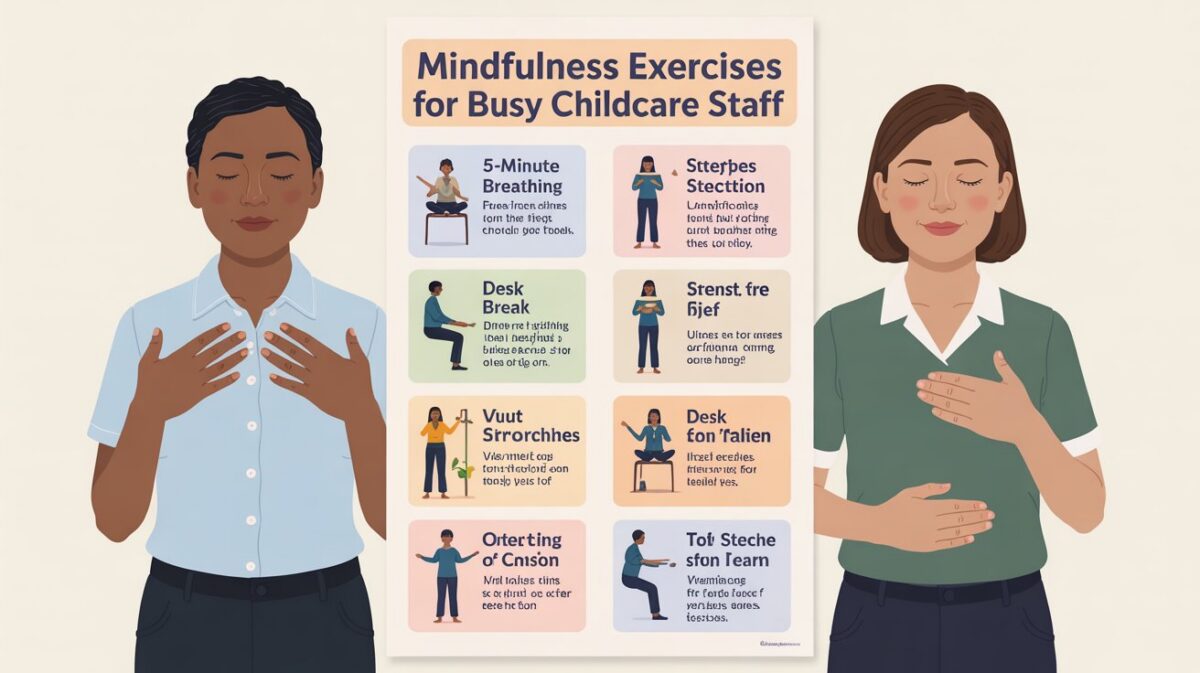
Childcare professionals face constant demands: rapid decision-making, continuous supervision, and sustained emotional labor. These factors raise stress and reduce capacity for patient, consistent responses. This article presents short, practical mindfulness techniques that integrate into daily routines and require minimal time for childcare staff. Each method includes clear steps, suggested timing, when to use it, and expected benefits. Use these techniques to shift from automatic reaction to intentional response, and to support team wellbeing across shifts.
Quick overview of techniques
The techniques below include S.T.O.P., grounding walk, 5-4-3-2-1 sensory checks, balloon breathing, mindful handwashing, intentional pauses, and a gratitude check. Each one fits into typical center routines—transitions, hygiene moments, and brief breaks—and most take under five minutes.
Core mindfulness techniques
Below are seven practical exercises. Each technique lists precise steps, ideal moments to use it, and approximate timing so staff can adopt them immediately.
S.T.O.P. technique
Use this when a sudden stressor arises and you need to regain clarity.
Steps
- Stop what you are doing.
- Take a steady breath in and out.
- Observe your internal state and surroundings.
- Proceed with a chosen, deliberate action.
When to use
Apply this in immediate stress moments: a child escalation, conflicting tasks, or a demanding family interaction.
Timing
About 30–60 seconds.
A short S.T.O.P. interrupts the stress loop and restores decision clarity. Staff can practice it silently between actions or as part of a brief huddle.
Grounding walk
A grounding walk anchors attention while staff remain active and on schedule.
Steps
- Walk a short distance, such as a hallway or between rooms.
- Focus on the sensation of each footstep.
- Inhale for three steps, exhale for four steps.
- Repeat until you feel present.
When to use
Use this during transitions: between groups, after a break, or when moving children from one activity to another.
Timing
One to three minutes.
This method keeps the body engaged and the mind present. It suits staff who prefer movement over stillness.
5-4-3-2-1 senses method
Use this when sensory overload or emotional pressure reduces functioning.
Steps
- Identify five things you see.
- Identify four things you feel.
- Identify three things you hear.
- Identify two things you smell.
- Identify one thing you can taste.
When to use
Apply during high-arousal moments: loud activity, crowded spaces, or after a difficult interaction.
Timing
About 30–60 seconds.
The exercise redirects attention from rumination to the immediate environment and reduces physiological arousal.
Balloon breathing
A movement-based breathing exercise suitable for classroom reintegration.
Steps
- Inhale deeply while raising both arms overhead in a balloon shape.
- Exhale slowly while lowering arms to the sides.
- Repeat three times, with slow, full breaths.
When to use
Use before returning to active supervision, after a brief break, or when preparing to lead an activity.
Timing
Around 60 seconds.
This technique engages large muscle groups and emphasizes controlled exhalation to calm the nervous system.
Mindful handwashing
Turn an essential routine into a micro-practice to reset attention.
Steps
- Focus on the water temperature.
- Notice the scent and texture of the soap.
- Attend to the movement of your hands and the sound of water.
When to use
During routine hygiene: after diapering, before meals, or following outdoor play.
Timing
Fifteen to thirty seconds.
Mindful handwashing converts a mandated moment into an instant regulation practice without adding time.
Intentional pauses
Use existing cues in the environment to create predictable micro-breaks.
Steps
- Identify natural triggers (bell, transition song, phone tone).
- Pause at the trigger.
- Take three slow, mindful breaths.
- Proceed with the next task.
When to use
Apply at daily transition points or predictable alerts.
Timing
Fifteen to thirty seconds.
Intentional pauses weave mindfulness into routine flow, increasing the likelihood of consistent practice.
Gratitude check
A short practice that increases positive perspective and reduces cumulative stress.
Steps
- Take thirty seconds.
- Name one positive interaction or one contribution you made.
- Acknowledge the value of that moment.
When to use
At the end of a morning, after a difficult incident, or during a brief team check-in.
Timing
Thirty seconds.
A gratitude check shifts focus to concrete wins and supports team morale without adding tasks.
Why these techniques produce results
Mindful breathing and focused attention change physiological responses. Controlled inhalation and extended exhalation stimulate the vagus nerve, which often lowers heart rate and reduces physiological tension. Cognitive shifts occur when staff interrupt automatic reactions and create space for deliberate choices. Movement-based exercises, such as grounding walk and balloon breathing, combine somatic regulation with attention training, producing faster recovery in high-demand settings. Over time, consistent micro-practices reduce acute stress spikes and improve overall emotional regulation.
Benefits for staff and children
Implementing short, routine mindfulness practices delivers both operational and relational benefits.
- Reduced stress response: staff experience lower heart rate and improved recovery after stress.
- Improved interaction quality: increased patience and focused engagement with children.
- Modeling calm behavior: children observe adults managing stress constructively, which supports their self-regulation.
- Routine fit: most practices take under five minutes and align with existing workflows.
These benefits translate into measurable improvements: fewer incidents, better staff retention, and smoother daily operations.
Implementing practices in daycare settings
Successful rollout requires minimal training, clear triggers, and visible support from leadership. Begin with a brief staff session, demonstrating each practice and encouraging team experimentation. Integrate practices into existing cues—attach the S.T.O.P. technique to arrival routines, the grounding walk to transitions, and mindful handwashing to hygiene protocols.
Leaders should adopt a pilot approach: test practices for 30 days, measure uptake, and adjust based on feedback. Use simple metrics such as break compliance and average mood score to track progress. Visual reminders—posters by sinks, floor markers, or brief scripts on the staff board—support consistent use.
ECE University provides practical, accredited modules that leaders can assign for professional development, which align with these implementation steps and include downloadable tools and templates for classroom application. These resources can accelerate adoption and provide CEUs for staff training.
Training and leader actions
Leaders should plan a short demonstration (15–30 minutes) for staff, covering technique practice and application scenarios. Provide a one-page checklist with trigger suggestions and timing estimates. Create a two-week pilot schedule with assigned owners: project lead, PD coordinator, and coverage manager. During the pilot, hold brief weekly check-ins to surface barriers and adapt procedures. Use the following structure to keep rollout focused and measurable:
- Staff briefing and demonstration.
- Pilot start with clear goals.
- Weekly huddles for feedback.
- Midpoint review and adjustments.
- Final report and next steps.
This structure creates accountability and produces evidence for continued investment.
Measurement and reporting
Measurement converts practice into organizational support. Use a lean KPI set and regular reporting to leadership. Suggested indicators include daily mood scores, weekly break compliance, monthly turnover rate, and substitute costs. Present results in a one-page leadership summary that pairs KPIs with staff feedback and pilot outcomes; this format helps secure modest investments such as counseling stipends, protected PD time, or temporary relief staffing.
Document the connection between improved metrics and operational outcomes. Leaders often respond to clear, operational rationale tied to cost, quality, or retention improvements.
Practical tips and troubleshooting
Keep these guidelines in mind during adoption.
- Keep each practice under five minutes to ensure regular use.
- Offer options so staff can choose what fits their style—breathing, movement, or sensory checks.
- Normalize imperfect practice; short, irregular practice still delivers benefit.
- Pair mindfulness with peer support; brief post-shift gratitude shares increase social reinforcement.
- If a practice is unpopular, pilot an alternative rather than abandoning the concept.
These adjustments preserve feasibility and improve sustained adoption.
Practical add-ons and tools
Provide staff with ready materials that remove design burden and increase consistent use.
- Printable 1-page checklist with techniques and trigger suggestions.
- Short audio guide (60–90 seconds) for balloon breathing and S.T.O.P. that staff can play on a device.
- Templates: break-rotation spreadsheet, mood-log CSV, and debrief script.
- Internal link to the mental-health pillar post for expanded context and policy guidance: Supporting Educator Mental Health in Daycare.
These tools accelerate uptake and support measurement.
Classroom integration and child engagement
Mindfulness need not be staff-only. Short, age-appropriate regulation activities simultaneously model calm behavior and support children’s self-regulation. Integrate movement-based techniques during transitions so children learn alongside staff. For example, lead a brief balloon breathing exercise before circle time. Keep child-facing practices short, concrete, and consistent.
When staff model regulation, children benefit through reduced incidents and more consistent routines.
Safety and escalation
Organizations must identify clear thresholds for clinical intervention. Escalate when staff show persistent low mood over two weeks, marked changes in sleep or appetite, or functional impairment. Provide confidential referral pathways such as Employee Assistance Programs, community mental health clinics, or teletherapy providers. Leaders should maintain a resource list and assist with referrals when appropriate. Early intervention reduces longer-term impairment and demonstrates organizational commitment.
Sample 30-day starter plan
Use a phased plan to build habits quickly and sustainably.
- Week 1 — Foundations: establish three 60-second breathing breaks per shift; begin mood logging.
- Week 2 — Operational alignment: pilot protected mid-shift breaks; start daily 5-minute huddles.
- Week 3 — Skill building: complete one short PD module on stress management and apply one new transition routine.
- Week 4 — Consolidation and advocacy: compile baseline metrics, present pilot outcomes, and recommend next steps such as PD budgeting or a counseling stipend.
Assign owners for each week and set checkpoints to preserve momentum.
Final note
Even short, repeatable practices move teams from reaction to reflection. Try one technique today, track its effect for a week, and share results during your next staff huddle. For teams seeking structured training and CEU-qualified modules that support rollout, consider ECE University’s course offerings and professional development resources to provide staff with accredited, practical training. These options align with the steps and templates described here and help integrate practice with measurable outcomes.
And finally, a closing play on the main keyword: practice mindfulness exercises for busy childcare staff, and make busy days mindful at last.
FAQs
How quickly will staff notice improvements?
Brief practices reduce acute stress within minutes; sustained reductions in burnout risk require consistent practice and supportive workplace systems over several weeks.
Must Read: “Supporting Educator Mental Health in Daycare Settings“
Can a small center implement these techniques?
Yes. Small centers should start with low-cost, high-impact changes: a buddy system for breaks, a daily 5-minute huddle, and a printed checklist. These steps scale based on measured outcomes.
How do we fund small wellbeing initiatives?
Start with a pilot and measure outcomes such as reduced absenteeism and fewer substitutes. Use those metrics to justify modest investments such as counseling stipends or protected PD time.
What if staff resistance slows adoption?
Offer choices and normalize short practice. Engage staff in selecting triggers and tools. Leadership modeling and brief training sessions increase buy-in.
When should a leader refer a colleague to clinical services?
Refer when you observe persistent mood deterioration for two weeks, functional impairment, or talk of self-harm. Offer to help connect them to confidential supports.