
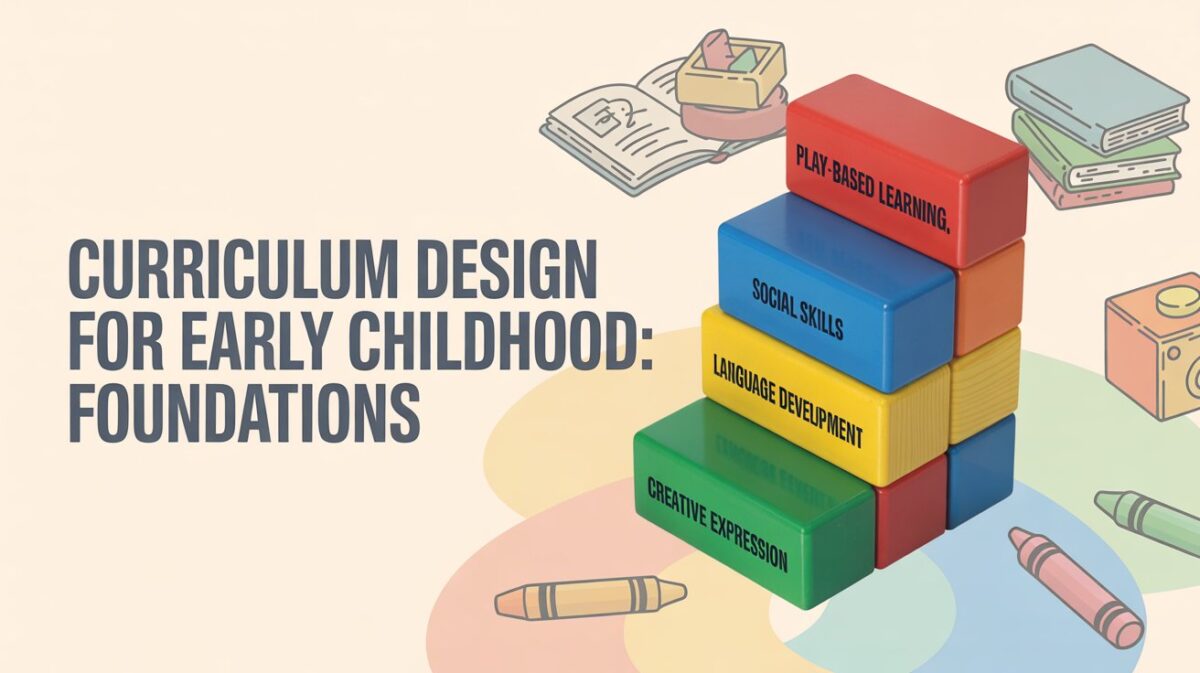
Curriculum Design for Early Childhood: Foundations and Best Practices
Curriculum design for early childhood isn’t just about lesson plans. It’s the blueprint for a child’s first experiences with learning, relationships, and the world. In the United States, early childhood programs shape school readiness, close opportunity gaps, and support working families.
With expanding pre-K programs, renewed research on play and nature-based learning, and ongoing debates about quality and equity, a practical, research-backed approach to curriculum design is more important than ever.
This article guides U.S. educators, program leaders, and policymakers through the foundations, practical strategies, and professional learning opportunities that can help transform early education today.
Background and Context: How Early Childhood Practice Evolved
Historically, early childhood education in the U.S. has shifted between academic school-readiness models and developmentally focused practices that emphasize play, relationships, and social-emotional growth.
Over recent decades, national organizations have championed the concept of Developmentally Appropriate Practice (DAP), which ensures that learning experiences match children’s age, individual differences, and cultural backgrounds.
Public investment in early education has also grown, with state-funded pre-K and Head Start programs reaching millions of children. However, quality and access still vary across states and communities, leaving many children without consistent early learning opportunities.
Key Concepts and Terms
Before exploring best practices, let’s clarify a few important terms you’ll see throughout this article.
Curriculum (Early Childhood Context): A structured framework that includes learning goals, teaching methods, environments, assessments, family engagement, and teacher development.
Developmentally Appropriate Practice (DAP): Teaching that aligns with what is known about child development and respects each child’s individuality and cultural identity.
Play-Based Learning: Learning that happens through both child-initiated and teacher-guided play. It’s purposeful and intentional, not unstructured free time.
Inclusive Curriculum / Universal Design for Learning (UDL): Designing lessons that meet the needs of all children, regardless of ability, language, or background.
Nature-Based Learning: Using outdoor environments and natural materials as key components of early education to promote exploration, creativity, and well-being.
The Current State of Early Childhood Education in the U.S.
Several key facts highlight the current landscape:
- About 59% of U.S. children aged 3 to 5 are enrolled in school settings. Pre-K access is growing but not yet universal.
- Programs like Head Start continue to serve hundreds of thousands of children from low-income families every year.
- The early childhood workforce faces major challenges such as teacher shortages, low pay, and high turnover. These issues affect how effectively a curriculum can be implemented.
These realities mean that curriculum design in the U.S. must be both research-based and practical, taking into account funding limitations, staffing needs, and community priorities.
Why Play, Inclusion, and Nature Matter
Play Builds Strong Foundations
Play is one of the most effective ways children learn. It supports social-emotional growth, language skills, and problem-solving abilities. When teachers intentionally guide play, children build essential skills that prepare them for school and life.
Inclusion Improves Learning for All
An inclusive curriculum ensures every child can participate and succeed. Using Universal Design for Learning (UDL) principles gives children multiple ways to engage, access information, and express what they know.
Nature-Based Learning Enhances Development
Outdoor learning isn’t just recreation. Studies show that regular outdoor play improves creativity, cooperation, and attention. Even programs with limited outdoor space can benefit from short daily sessions outside or the use of natural materials indoors.
Challenges in Curriculum Design
Designing effective curricula is not easy. Here are some challenges educators face across the U.S.:
- Uneven teacher training: Many teachers lack access to ongoing professional development that connects directly to classroom practice.
- Funding pressures: Programs often focus on enrollment numbers rather than quality indicators, which can shift attention away from developmentally appropriate learning.
- High staff turnover: Low wages and high stress levels make it hard to maintain consistency in curriculum implementation.
- Balancing access and quality: Expanding pre-K programs without investing in teacher support and materials can lead to uneven outcomes.
Opportunities and Practical Strategies
Despite the challenges, many programs are making progress by adopting simple, proven strategies.
1. Prioritize Play with Learning Goals
Set clear, observable learning objectives for playtime. Teachers can observe and document how children develop language, math, or problem-solving skills during guided play.
2. Use Universal Design for Learning
Plan activities that offer multiple ways for children to participate and demonstrate learning. This supports children with diverse learning styles and abilities.
3. Include Outdoor Learning Every Week
Turn even small outdoor areas into dynamic learning environments. Rotate materials, introduce sensory stations, and organize short nature walks to promote curiosity and connection.
4. Invest in Coaching, Not Just Workshops
Professional growth is most effective when paired with ongoing feedback. Coaching cycles, classroom observations, and peer learning groups help teachers sustain new practices.
5. Focus on Formative Assessment
Observation-based assessments, such as learning stories and digital portfolios, provide meaningful data to guide instruction without interrupting play or adding stress.
Case Studies and Real Examples
State Pre-K Programs
Some states have successfully expanded access to pre-K while maintaining quality by linking funding to teacher training and the use of approved curriculum models.
Nature-Based Urban Programs
Community centers in urban areas have turned small outdoor spaces and local parks into outdoor classrooms. The result: higher engagement and improved language development among young learners.
Coaching Success Stories
Programs that added coaching cycles for teachers saw noticeable improvements in how educators guided play and assessed learning. Children showed stronger social and cognitive skills as a result.
Expert Insights
Experts in early childhood education agree on several key points:
- Curriculum design should always align with developmentally appropriate practice.
- Teachers need ongoing professional learning, not just one-time training.
- Curricula should be flexible, inclusive, and culturally responsive.
- Expanding early learning access must go hand in hand with quality improvement and workforce investment.
A Step-by-Step Plan to Start Now
Here’s a quick six-step plan any program can use:
- Set clear learning goals. Choose three core focus areas such as language, self-regulation, and numeracy.
- Protect play and outdoor time. Schedule two daily play blocks and one weekly outdoor session.
- Provide training and coaching. Enroll teachers in an online course, then follow up with classroom coaching.
- Document learning. Capture two learning observations per child each week.
- Adjust instruction. Use data to modify materials and teaching approaches.
- Engage families. Share learning stories and invite input on cultural materials or activities.
Where to Learn More
If you’re an educator or program leader in the U.S. looking for affordable, CEU-approved professional development, consider ECE University.
Their Curriculum (CU) Courses cover topics such as play-based planning, emergent curriculum, lesson planning, and integrating literacy, math, and social-emotional learning into everyday activities. These online courses are designed for working professionals and accepted for CEUs across all 50 states.
Pairing an online course from ECE University with coaching can help you quickly apply what you learn and strengthen classroom quality.
Benefits of Effective Curriculum Design
A strong curriculum benefits children, families, and communities:
- Improved school readiness: Children enter kindergarten with better language, math, and social-emotional skills.
- Greater equity: Inclusive approaches support diverse learners and reduce achievement gaps.
- Community impact: High-quality early learning supports family stability and long-term educational success.
Future Trends in Early Childhood Curriculum
Here’s what educators and policymakers should watch in the coming years:
- Customizable modular curricula that let programs adapt content while keeping core learning goals.
- Digital assessment tools that simplify observation and documentation.
- Stronger workforce policies that improve teacher pay, coaching, and career advancement.
- Growth in outdoor and environmental education as climate and sustainability gain national focus.
Conclusion
In the United States, early childhood curriculum design is about much more than lesson planning. It’s a full system built on relationships, play, inclusion, and teacher growth.
When educators design intentionally, use observation to guide learning, and engage in ongoing professional development, children thrive.
Start small — one guided play lesson, one outdoor session, one coaching cycle — and watch meaningful change unfold in your program.
For Educators: Try one new guided play activity this week and record your observations.
For Program Leaders: Enroll your teachers in a CEU-approved Curriculum (CU) Course from ECE University. These short, flexible courses are built for busy professionals.
FAQs
1. What is curriculum design in early childhood?
Answer: Curriculum design in early childhood is a structured plan that defines learning goals, teaching approaches, environments, assessment, and family engagement for young children. It guides day-to-day practice so experiences are developmentally appropriate and meaningful.
2. Why is curriculum design important for early childhood programs?
Answer: Because it ensures learning is intentional, equitable, and aligned with child development goals. A strong curriculum improves school readiness and supports consistent, high-quality experiences across classrooms.
3. What are the core principles of effective early childhood curriculum design?
Answer: Core principles include developmentally appropriate practice, play-based learning, inclusivity, assessment for learning, and family partnership. These principles ensure children’s social, emotional, cognitive, and physical growth is supported.
4. How does play-based learning fit into curriculum design?
Answer: Play-based learning is the primary vehicle for exploration, language, and problem-solving in early childhood curricula. When planned with clear learning intentions and adult scaffolds, play produces measurable developmental gains.
5. What does an inclusive curriculum look like for young children?
Answer: An inclusive curriculum uses Universal Design for Learning (UDL) to offer multiple ways to engage, represent content, and let children express learning. It also includes adaptations, family collaboration, and specialist input when needed.