
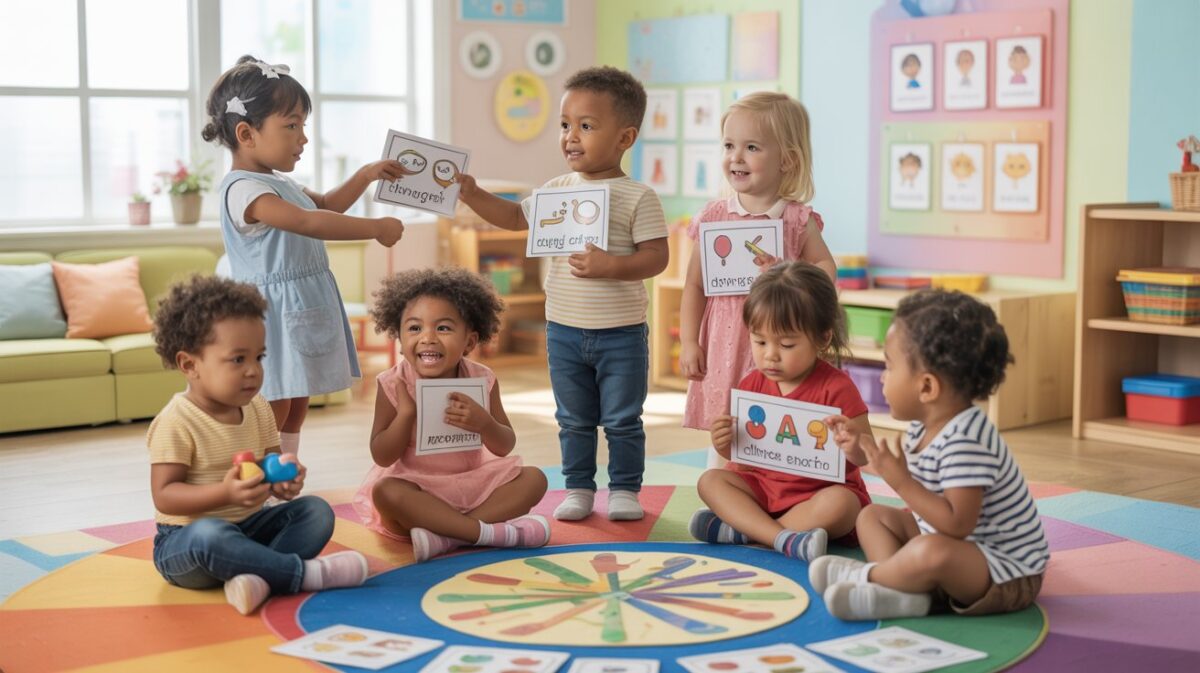
Social Emotional Learning Activities for Early Childhood Growth
Social emotional learning sets the stage for how children manage feelings, form relationships, and make choices. For early childhood, targeted social-emotional learning activities build language for feelings, routines for regulation, and simple strategies for cooperation. This article outlines practical steps, ready-to-use activities, and measurement approaches that educators and caregivers can adopt immediately to support children’s early development.
What is SEL?
Social-emotional learning (SEL) in early childhood teaches children to recognize feelings, manage reactions, and interact with others in constructive ways. Unlike later grades, early childhood SEL focuses on co-regulation, attachment, and brief, repeatable practices that match short attention spans and rapid brain growth.
Key features of early SEL
Early SEL centers on:
- Adult-child co-regulation rather than independent self-regulation.
- Repetition and routine as learning drivers.
- Play and language are primary learning modes.
Why SEL matters benefits
Early social-emotional learning activities support immediate classroom functioning and long-term outcomes. They reduce conflict, strengthen attention, and enable children to engage more fully in learning tasks. Over time, SEL contributes to improved academic readiness, healthier peer relationships, and better emotional health.
Evidence-aligned benefits
- Emotional regulation: Children learn strategies to calm and refocus.
- Social skills: Structured practice improves sharing, turn-taking, and collaboration.
- Language development: Naming feelings expands vocabulary and self-expression.
- Attention and readiness: Predictable routines increase on-task behavior.
- Long-term outcomes: Early SEL correlates with fewer behavior challenges and stronger relationship skills later in life.
Target ages and developmental milestones
Effective SEL activities align with age-specific milestones. Below is a concise guide to what to expect and when to provide targeted support.
Infants (0–12 months)
Infants form attachment and rely on caregivers for co-regulation. Activities should prioritize responsive interactions, gentle routines, and consistent cues.
Toddlers (1–3 years)
Toddlers begin naming emotions and engage in parallel play. Short, concrete activities that label feelings and model turn-taking work best.
Preschoolers (3–5 years)
Preschoolers develop empathy, basic problem-solving, and more sustained cooperative play. Use slightly longer activities that involve role play and group negotiation.
Signs to watch for support
Watch for persistent difficulty with calming, extreme withdrawal, or aggressive patterns that do not improve with routine support. These may warrant consultation with a specialist.
Core SEL competencies for early childhood
Early SEL breaks down into five practical competencies. Activities should target these explicitly.
Self-awareness
Children learn to identify feelings and preferences. Simple prompts and naming help build this skill.
Self-management
Teach brief calming strategies and routines that children can adopt repeatedly.
Social awareness
Guide children to recognize others’ emotions and perspectives through stories and role play.
Relationship skills
Practice sharing, turn-taking, and conflict resolution through guided activities.
Responsible decision-making
Offer structured choices and problem-solving prompts that match developmental capacity.
Activity design principles
Design activities to be short, predictable, and play-driven. The goal is consistent exposure and positive adult scaffolding.
Practical design rules
- Keep activities short: 3–15 minutes, depending on age.
- Use multimodal input: songs, books, movement, and tactile materials.
- Scaffold: model language, then invite participation.
- Repeat: embed activities into routines for mastery.
- Low-prep: favor materials that are inexpensive and portable.
Sample activities by competency and age
Below are tested activity templates you can adapt forthe classroom or home. Each entry lists age, duration, materials, goal, steps, and variations.
Feelings Faces (Self-awareness)
- Age: Toddler/Preschool
- Time: 5–10 minutes
- Materials: mirror, emotion cards, or simple drawings
- Goal: Name and match feelings
Steps: Show an emotion card and name it clearly, ask the child to make the face in the mirror, invite the child to mimic the face, or pick the card that matches their mood, and praise attempts while labeling behavior (“You chose happy because you’re smiling.”).
Variation: Use family photographs or create a personal feelings collage.
Calm-Down Corner & Breathing Jar (Self-management)
- Age: All ages
- Time: 3–7 minutes
- Materials: clear jar, water, glitter, small soft pillow
- Goal: Practice a calm-down routine
Steps: Introduce the corner and model how to sit quietly, use a breathing prompt such as “Smell the flower, blow the candle,” shake the jar, and watch glitter settle as a visual for slowing down, and invite reflection: “How do you feel now?”
Variation: Replacethe jar with a stress ball or a short guided breathing song.
Emotion Storytime (Social awareness & language)
- Age: Infant–Preschool
- Time: 10–15 minutes
- Materials: a picture book about feelings
- Goal: Identify emotions in context
Steps: Read a short story, pausing to name characters’ feelings; ask one or two open questions such as “How did she feel? Why?”; encourage children to act out a scene or show the face that matches the emotion; and reinforce vocabulary by repeating emotion terms across the week.
Variation: Use puppets to reenact scenes.
Turn-Taking Games (Relationship skills)
- Age: Toddler/Preschool
- Time: 5–15 minutes
- Materials: soft ball, props
- Goal: Practice waiting and sharing
Steps: Set a simple rule such as one pass per child, model counting turns, or using a timer, reinforce descriptive praise (“You waited and then passed. Nice job.”), and if conflict appears, guide a brief repair script: “You were waiting; can you say, ‘Your turn’?”
Variation: Build with blocks where children add one piece in turn.
Problem-Solving Puppet Play (Decision-making)
- Age: Preschool
- Time: 10–15 minutes
- Materials: puppets or stuffed animals
- Goal: Propose solutions and negotiate
Steps: Create a short conflict scenario with puppets, invite children to suggest solutions, act out the chosen solution and discuss outcomes, and repeat with alternative options to show consequences.
Variation: Use real classroom scenarios and have children role-play
Kindness Hunt (Empathy & prosocial behavior)
- Age: Preschool
- Time: 10–20 minutes
- Materials: simple checklist or stickers
- Goal: Notice and perform kind acts
Steps: Read a brief prompt about kindness, ask children to find one kind act to do during a session, gather and share what each child did, and add a marble or sticker to a shared jar for every act.
Variation: Rotate prompts to focus on sharing, helping, or compliments.
Emotion Charades (Advanced naming & perspective-taking)
- Age: Preschool
- Time: 10 minutes
- Materials: none
- Goal: Interpret body language and name emotions
Steps: Demonstrate an emotion using facial expression and posture, invite children to guess and name the emotion, rotate so each child has an opportunity to act, and debrief by asking when they might see that emotion in real life.
Variation: Use situational cards for older preschoolers.
Sensory and adaptive variations
Use tactile emotion cards for neurodiverse learners, add a quiet visual schedule for each activity, and offer fidget tools in calm-down spots.
Low-prep home-friendly activity
“Feelings Check-In” at mealtimes: ask one or two simple prompts each day to practice naming and reflecting on emotions.
Implementation guide for classrooms and homes
Consistency matters. Put short SEL moments into predictable parts of the day.
When to schedule activities
- Morning circle: check-in and feelings naming.
- Transitions: 1–3 minute calming practices before or after recess.
- Small-group time: targeted practice like puppet play or turn-taking.
- Before nap or quiet time: brief breathing practice.
Grouping and ratios
- Whole-group: introduce concepts and model language.
- Small-group (3–6 children): practice turn-taking and problem-solving.
- 1:1: intensive co-regulation for targeted support.
Maintain appropriate adult: child ratios and ensure adults rotate to provide consistent modeling.
Role of the adult
Adults should model emotional language, narrate observations, scaffold responses, and expand children’s phrasing. For example: “You look upset. Can you show me with your words?” Then offer a brief strategy: “Let’s take three big breaths together.”
Materials and low-cost alternatives
- Emotion cards: DIY from printed images or drawings.
- Calm-down jar: water and glitter in a recycled jar.
- Puppets: socks or simple craft puppets.
- Books: Use classroom libraries or community library loans.
Professional study and recommended ECE training
Structured ECE training helps professionals translate theory into effective, consistent classroom practice. Programs that combine applied learning, supervised experience, and practical assessment tools allow educators to implement social-emotional strategies in real settings confidently.
When selecting an ECE program, prioritize applied SEL coursework, supervised practicum or internships, inclusion and neurodiversity support strategies, family engagement practices, and clear assessment frameworks.
A strong example is the Soft Skills & Self-Development course by ECE University, which aligns well with these priorities. The course focuses on practical social-emotional competencies, self-regulation, communication, and professional growth—skills that directly support the implementation of Social Emotional Learning Activities for Early Childhood Growth in classrooms and care settings.
Investing in focused ECE training strengthens professional confidence, improves classroom consistency, and supports measurable developmental outcomes. Educators are encouraged to apply learning immediately by piloting SEL routines, documenting progress, and refining practice through ongoing professional development.
Inclusion and cultural responsiveness
Make SEL relevant to each child’s background and needs.
Culturally relevant practice
Use names, stories, and examples that reflect children’s families, and invite families to share cultural practices that express care or calm.
Neurodiversity support
Provide visual schedules, clear steps, and sensory options. Break activities into smaller steps and use consistent cues.
Language support for bilingual families
Use dual-language labels for feelings and encourage families to teach emotion words in the home language and use them in class.
Family engagement strategies
Families amplify SEL gains when they receive practical tools and brief communication.
Quick home activities
- Feeling check-in: a two-question ritual at breakfast or bedtime.
- Story prompts: ask caregivers to ask a single emotion question after a book.
Communication templates
Use short notes or messages that clearly state progress and a suggestion. Example: “Today Alex practiced waiting while playing. Try a 2-minute turn-taking game at home tonight.”
Workshops and take-home resources
Offer a 20–30 minute parent session or send a printable card with three activities that require no materials.
Assessing progress with simple tools
Assessment for early SEL should be observational, brief, and focused on behavior trends.
Observation checklist (sample items)
- Name basic emotions (yes/no)
- Uses breathing or calm strategy when upset (emerging/developing/confident)
- Waits for turn in small group (emerging/developing/confident)
Anecdotal notes and learning stories
Record short descriptions of interactions that illustrate growth. Include context and next steps.
Sample rubric
Rate behaviors across three levels:
- Emerging: occasional or prompted use
- Developing: consistent with scaffolding
- Confident: independent and generalized
When to refer
Refer when developmental progress stalls or behaviors suggest risk to safety or learning, such as frequent aggression that does not respond to routine supports.
Troubleshooting and common challenges
SEL activities will face resistance and variable engagement. Address common problems with clear strategies.
Resistance to activities
Shorten sessions and reduce steps, offer choices and let children opt in after a brief invitation, and model with a peer or an adult first to reduce uncertainty.
Managing strong emotions in groups
Move to a calm-down corner, use simple scripts that label the emotion and offer a strategy, then re-enter the activity. Debrief later with the individual rather than in front of the group.
Frequent conflicts and repair steps
Teach a simple repair script:
- Name the harm: “You grabbed my toy.”
- Express feeling: “That made me sad.”
- Offer solution: “Can you give it back and share next time?”
Sample one-week plan
Below is a compact schedule that fits a classroom or home routine. Each line lists the morning circle activity, a transition activity, a small-group activity, and a home practice suggestion.
Week at a glance
- Monday: Morning check-in (feelings faces); Transition breathing; Small-group emotion story; Home: ask about one feeling at dinner.
- Tuesday: Gratitude jar intro; Transition: whole-body listening; Small-group turn-taking game; Home: share one kind act.
- Wednesday: Puppet problem scenario; Transition: movement song about emotions; Small-group calm-down practice; Home: read an empathy-focused story.
- Thursday: Emotion charades; Transition: breathing jar; Small-group collaborative art project; Home: feelings check-in at bedtime.
- Friday: Kindness hunt recap; Transition: guided relaxation; Small-group reflection circle; Home: family compliments around the table.
Safety, ethics, and consent
Ensure safety and respect in all SEL activities.
Supervision and physical safety
Always supervise sensory items and small parts. Ensure materials do not present allergy or ingestion risks.
Respecting boundaries and privacy
Never pressure children to disclose traumatic experiences. Obtain caregiver consent before sharing photos or assessments publicly.
Data and sharing
Keep assessment notes secure and share summaries with caregivers only as appropriate.
Resources and further reading
Below are practical resources for additional tools and curriculum ideas:
- Early childhood SEL curriculum guides (search local education department resources)
- Picture books on feelings (library lists)
- Parent handouts that reinforce short daily check-ins
- Evidence sources: look for early childhood research centers and peer-reviewed work on SEL outcomes
Final remarks
Implementing social-emotional learning activities requires modest planning and consistent practice. Start with two or three activities from this guide, embed them in daily routines, and communicate progress to families. When adults model phrases for feelings and calm strategies consistently, children internalize those processes and apply them across settings. Try a small pilot this week and note what works; iteration will refine practice and yield measurable improvements.
Give one of the provided activities a trial run today and share results with your team or family to build momentum.
FAQs
What are the practical first steps for a busy classroom?
Start with a daily 3–5 minute feelings check-in during morning circle and a two-minute breathing routine after recess. Use simple materials like a mirror or a jar.
How can caregivers reinforce these practices at home?
Share one activity and a script, such as a two-question check-in, and encourage families to practice it for a week. Keep instructions brief and consistent.
How do I adapt activities for nonverbal or minimally verbal children?
Use visual supports, emotive pictures, and gesture-based prompts. Allow children to point or indicate feelings with cards rather than verbal naming.
What signs indicate a need for specialist referral?
Persistent, intense aggression, lengthy withdrawal, or emotional responses that interfere with daily functioning despite consistent SEL supports.
Can these activities support bilingual learners?
Yes. Label feelings in both languages and invite families to teach emotion words at home. Dual-labeling enhances vocabulary and comprehension.