
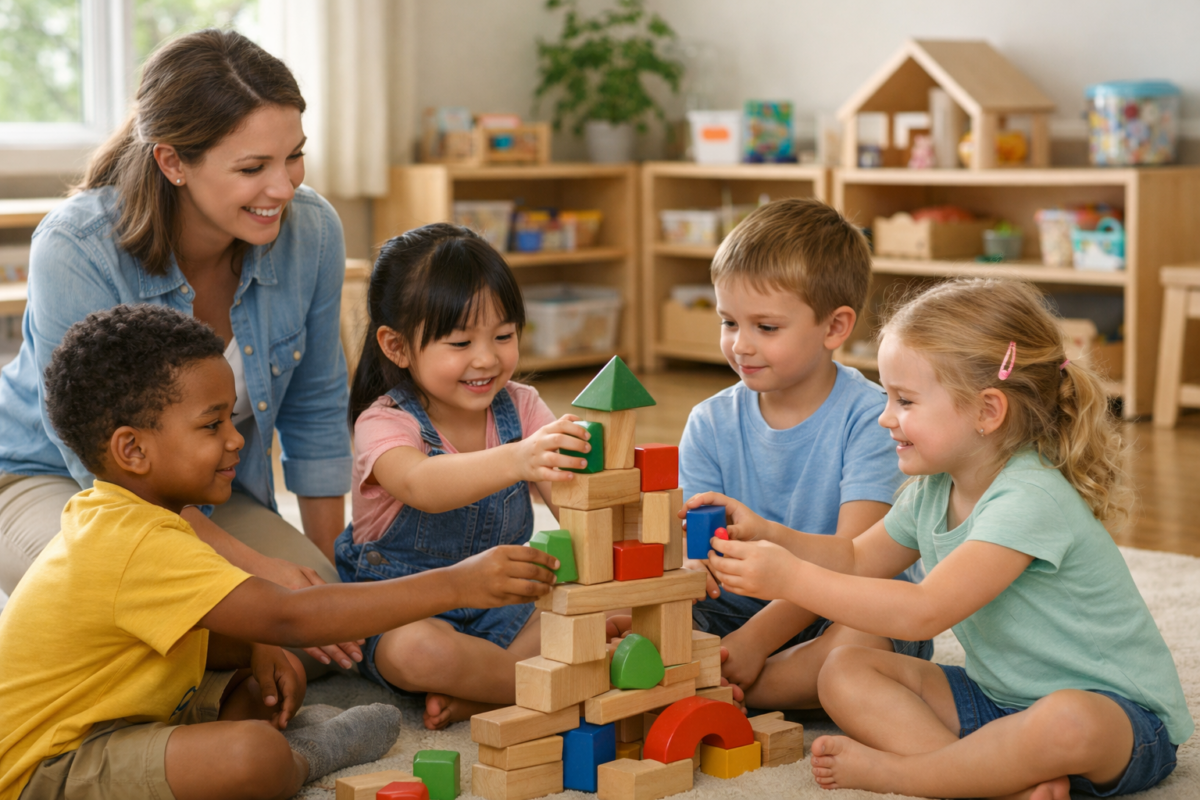
Using Play to Build Social Skills in Preschool
Social skills shape how children join groups, follow routines, and resolve conflict. For preschool teachers, those skills link directly to classroom functioning, learning readiness, and daily interactions. Play provides a context where teachers can teach, observe, and measure social development without interrupting natural behavior. This article argues that structured and facilitated play is the primary vehicle teachers can use to teach and assess social skills, and it offers a practical roadmap for implementation. You will find clear objectives, evidence-based rationale, teacher strategies, six classroom-ready activities, assessment tools, inclusion guidance, and a weekly implementation plan.
Learning objectives
Before moving into methods and activities, target clear outcomes.
- Identify four core social skills: sharing, turn-taking, communication, emotion regulation.
- Describe teacher strategies to scaffold those skills through play.
- Access six ready-to-use activities with scripts and extension options.
- Apply simple assessment tools to monitor progress and inform instruction.
Evidence and rationale
Research supports child-led play, guided play, social learning theory, and the zone of proximal development as foundations for social skill acquisition. Teachers act as facilitators who model language, set expectations, and shape interaction opportunities. Guided play, where adults scaffold but do not dominate, produces measurable gains in language and cooperative behaviors. In short, play provides repeated, contextualized practice under teacher supervision, which accelerates social competence.
Core teacher strategies
Successful transfer from play scenarios to durable social skill requires strategy. The following paragraphs outline teacher responsibilities and practical techniques.
Intentional setup
Design the physical and social environment with goals in mind. Allocate clear zones and arrange materials that invite sharing and joint action. Label spaces to signal expectations and rotate thematic materials to stimulate sustained engagement.
Scaffolding
Use prompts, modeling, and gradual withdrawal of support. Offer language frames – brief, repeatable phrases teachers and children use during play. Start with heavy support, then reduce prompts as children internalize routines and vocabulary.
Facilitation techniques
Join play with a transparent role, coach during moments of tension, and use short mediation scripts to guide conflict resolution. Intervene to expand language, not to control outcomes. Use concise feedback that names the target skill and suggests a next step.
Peer pairing and group structuring
Form pairs and small groups intentionally. Mix skill levels so children model each other. Rotate partners regularly to broaden social exposure and reduce cliques. Use buddy systems to scaffold inclusion and peer coaching.
Routine integration
Embed social-skill prompts into daily routines – arrival, snack, transition, and clean-up. Short, repeatable moments reinforce learning and build automaticity. Document routine-linked successes to show incremental gains.
Using Play to Build Social Skills in Preschool – Six practical activities
Below are six classroom activities formatted for immediate use. Each activity includes objective, materials, step-by-step directions, teacher prompts, and extension options.
Dramatic play: Market role-play
Objective: Practice sharing, negotiation, and role-based language.
Materials: Play food, shopping baskets, play money, price tags, simple checklists.
Step-by-step:
- Set up stations: produce, bakery, checkout. Display price tags.
- Assign roles for a rotation period – vendor, shopper, cashier.
- Model an interaction: vendor names item, shopper requests a quantity, cashier counts money.
- Invite children to play for 10-15 minutes. Rotate roles after a set time.
Teacher prompts:
- “Can you tell the vendor how many apples you want?”
- “How much will that cost if we buy two?”
- “Show me how you ask for more time with the scale.”
Extension:
- Add a budgeting challenge: provide a small amount of play money and a shopping list. Encourage negotiation when funds are limited.
Notes:
- Focus on language scaffolding during turn changes. Document common negotiation phrases and coach alternatives when conflict arises.
Turn-taking games with visual timers
Objective: Build patience, impulse control, and rule-following.
Materials: Visual timers, simple board games, turn tokens.
Step-by-step:
- Introduce the concept of the timer and demonstrate its use.
- Use a short game that requires alternating turns. Put a large visual timer in the center.
- Assign a turn token; only the child holding the token may move.
- Praise wait behavior and reinforce verbal turns (“My turn, thank you”).
Teacher prompts:
- “What do you say when it’s someone else’s turn?”
- “How long will you wait while Jamie takes her turn?”
Extension:
- Increase wait time or add multi-step turns to expand self-control demands.
Notes:
- Visual timers reduce ambiguity about duration and help children internalize waiting periods gradually.
Cooperative building project
Objective: Encourage collaboration, planning, and conflict resolution.
Materials: Large blocks, loose parts, plan templates (picture hints), tape measures.
Step-by-step:
- Present a shared challenge: build a bridge for toy cars that spans two chairs.
- Allow children to plan for five minutes with a simple sketch or talk.
- Assign roles: designer, builder, tester. Rotate roles mid-project.
- Test the structure and adjust collaboratively.
Teacher prompts:
- “What will happen if we move the supports closer?”
- “Who will test the car while others watch?”
Extension:
- Add a team reflection after testing: What worked? What will we change?
Notes:
- Use short, structured reflection to develop metacognitive language about collaboration.
Emotion charades
Objective: Build emotional vocabulary and empathy.
Materials: Emotion cards with faces and single-word labels, mirror area.
Step-by-step:
- Review a small set of emotion labels and possible body signals.
- Have children act out an emotion while peers guess.
- Discuss calming strategies or responses to each emotion.
Teacher prompts:
- “When someone looks sad, what could you say?”
- “How do we help if a friend seems angry?”
Extension:
- Combine with story time: stop a story and ask children to identify a character’s feeling and suggest a response.
Notes:
- Reinforce nonverbal cues and practice teacher-modeled responses that children can use later.
Small-group story creation
Objective: Practice perspective-taking, conversational turns, and narrative sequencing.
Materials: Picture prompts, story boards, simple recording device.
Step-by-step:
- Show a sequence of images and ask groups to create a short story.
- Allocate speaking turns and assign a scribe to arrange images in sequence.
- Encourage children to ask each other questions about character motives.
Teacher prompts:
- “Why did the character choose to leave?”
- “Can you ask Ayesha what happens next?”
Extension:
- Record each group’s story and listen back, prompting children to evaluate turn balance and clarity.
Notes:
- Use turn tokens during storytelling to ensure equitable contributions.
Guided free-play with social prompts
Objective: Encourage generalization of social skills across contexts.
Materials: Open-ended toys, prompt cards, observation checklist.
Step-by-step:
- Provide open-ended materials and leave a set of three social prompts visible.
- Use a gentle cue to steer play toward a prompt if the group strays.
- After play, hold a 3-minute debrief focusing on the prompt behaviors.
Teacher prompts:
- “Try this prompt: ‘Invite someone to help build a tower.’”
- “How did you ask for help when you needed it?”
Extension:
- Rotate prompt complexity across the week to scaffold deeper skill use.
Notes:
- Guided free-play supports transfer because children apply practiced skills spontaneously.
Assessment and progress monitoring
Assessments should be brief, repeatable, and integrated with play.
Observation checklist
Use a short checklist with target behaviors and frequency markers:
- Shares materials without prompting (never – sometimes – often).
- Initiates play with peers.
- Uses words to request or refuse.
- Accepts turns without protest.
Implement quick 5-minute observation windows daily and aggregate weekly.
Anecdotal records and short rubrics
Keep one-line anecdotes tied to specific activities. Convert recurring behaviors into rubric levels:
- Emerging – requires adult prompt.
- Developing – uses skill with occasional adult support.
- Proficient – demonstrates independent use in play.
Child self-assessment
For older preschoolers, use visual scales such as smiley faces. Ask simple questions: “Did you share today?” Let children mark their response to encourage metacognition.
Photos and video
With parental permission, record brief interactions for teacher review. Use clips to highlight progress and to coach children during reflection sessions.
Differentiation and inclusion
Design adjustments ensure equitable access to social learning.
Strategies for diverse learners
Provide visual cues, simplified language frames, and tactile supports for children with sensory differences. Use peer partners to model language and action. Pre-teach expected phrases to children who need additional rehearsal.
Adapting activities for developmental levels
Scale task complexity by reducing role demands, shortening turn lengths, or offering more structured roles. For advanced learners, layer in planning responsibilities and leadership roles.
Classroom design and materials
Physical layout influences social interaction.
- Create distinct zones: dramatic play, cooperative building, quiet conversation.
- Use low-friction, open-ended materials that invite sharing: blocks, fabric, connectors.
- Keep duplicate sets of popular items to reduce conflict over single resources.
- Position teacher observation points where adults can join without disrupting flow.
Family engagement and home extensions
Invite families into the learning loop with clear, concise tools.
- Send activity cards with materials lists and short prompts families can use at home.
- Share weekly highlights via a class message: one observed social success and a suggestion for a home activity.
- Ask families to record a short anecdote when they observe a targeted skill outside school.
Implementation plan – weekly sample
Structure a realistic schedule that fits a typical preschool week.
- Monday: Teacher-led dramatic play introduction – 15 minutes.
- Tuesday: Turn-taking game during circle time – 10 minutes.
- Wednesday: Cooperative building project in small groups – 20 minutes.
- Thursday: Emotion charades during morning routine – 10 minutes.
- Friday: Guided free-play with social prompts – 20 minutes.
- Daily: Short transition prompts that reinforce the week’s target skill.
- Weekly check-in: 10-minute assessment and one anecdotal note per child.
This plan delivers repeated practice, role rotation, and a brief assessment cycle to inform next-week adjustments.
Teacher reflection and professional tips
Reflection anchors continuous improvement.
- After each activity, ask: What worked? Which children needed more support? What language prompts changed behavior?
- Maintain a brief log of effective scripts and share them in team meetings.
- Use consistent classroom phrases that children hear across adults.
Quick mediation scripts:
- “Name the feeling – then name what you want.”
- “I see you need a turn. Tell them: ‘I’ll wait. Can I have a turn next?’”
- “Show me with your words, then show me with your hands.”
Resources and further reading
Select practical guides and short research summaries that support practice.
- Early childhood professional development modules focused on guided play.
- Teacher resource bundles with printable activity cards and observation forms.
- Short research summaries on social learning and play-based instruction.
Frequently asked questions
How often should teachers schedule social-skill play sessions?
Schedule short, focused sessions three times per week plus daily embedded prompts. Frequency supports rehearsal and generalization.
How do teachers measure progress without formal tests?
Use observation checklists, brief rubrics, and anecdotal records. Aggregate weekly to spot trends and adjust scaffolding.
What if a child resists group play?
Start with one-on-one scaffolding, then use a buddy system to reintroduce group roles. Offer predictable, low-pressure tasks initially.
Can social skills taught in play transfer to academic routines?
Yes. When teachers align language and expectations across play and routines, children apply strategies such as turn-taking in both contexts.
How should teachers involve families who speak a different language?
Provide translated activity cards or visual prompts; encourage families to model simple phrases in their home language and share them at school.